Over the last two days we have been putting up Little Tern fencing on the shingle ridge near the Watch House. One area to the east and another to the west. Little Terns have been settling in these two areas, as they do every year, so we have put up fences to protect them from disturbance. Oystercatchers and Ringed Plovers will benefit from this too, as they also nest on the shingle in these areas.
Yesterday a Cuckoo was spotted flying over the dunes. This was a first for the season.
- Ajay
Tuesday, 15 May 2012

Sunday, 13 May 2012
13th of May: Deer on the Point
Today, while conducting a breeding bird survey (BBS), a Muntjac deer was seen on Middle Point. The wardens got to within 5 metres before it noticed and ran away. The gulls and terns were not comfortable with it being so close to their nests, and they 'mobbed' it on the beach. Although deer mostly feed on vegetation, they occasionally eat eggs and young birds.
In addition to Muntjac, two other deer species have been recorded on the point. Red Deer (mentioned in our first post) and also Roe Deer have been seen. Although Chinese Water Deer are often seen nearby on the mainland at Cley and Blakeney, there are no records of them actually on the point.
In other news, we have 17 pints of milk and 16 bananas - any recipes welcomed!
- Ajay
Thursday, 10 May 2012
10th of May: Nest Recording
The breeding season is in full swing now and we are spending a lot of time looking for and monitoring nests. We are contributing to the BTO's (British Trust for Ornithology) nest monitoring scheme. This involves filling out a card for each nest found and briefly visiting it every four days to record the number of eggs and, later on, the number of chicks. In fact, today we watched a Meadow Pipit feeding a successfully fledged chick.
We are monitoring ten nests each. Species include Linnets, Meadow Pipits, Oystercatchers, Redshanks and Ringed Plovers. We also have a dissertation student from UEA (University of East Anglia, Norwich) monitoring a number of Oystercatchers.
We are not using the BTO nest monitoring scheme method to record individual tern nests because - aside from the fact that there are over 3,000 nests - it would involve walking into the colony, which would cause too much disturbance. Incubating terns are counted from a distance using a telescope.
Like on Tuesday, several Swifts, Swallows, House Martins and Sand Martins flew west over the point. In a 2 and-a-half hour period 1,782 Swifts, 834 Swallows and 522 House Martins were counted. Extrapolating from this, we estimate that around 5,000 Swifts flew over Blakeney Point today.

Swallow (Joe Cockram)

Above and below: Swift (Joe Cockram)

- Ajay
Wednesday, 9 May 2012
8th of May: Swallows
Throughout the day - which at times was actually almost warm - large numbers of Swallows were seen passing through. An estimated 3,000, along with around 100 House Martins and Sand Martins and about 200 Swifts. Sitting in the sand dunes counting them fly over, the Swifts flew very close, the sound of their beating wings clearly audible as they zoomed past. Swifts are in fact the fastest bird in self-propelled flight.
Swallows nest on the Point every year. Last year there was a nest in the men's toilets. This year we have put up 'swallow shelves' inside our new sheds and the newly refurbished Tern Hide. These are small wooden shelves screwed close to the roof, to encourage Swallows to nest. Some years these shelves are used more than others, ranging from 3 to 9 nests. It will be interesting to see how many of our new shelves get nested on this year.

We have also created a rock pile to attract Wheatears to breed. There are large numbers of Wheatears on the Point, but they have probably not successfully bred here since the 1930s.

Swallows nest on the Point every year. Last year there was a nest in the men's toilets. This year we have put up 'swallow shelves' inside our new sheds and the newly refurbished Tern Hide. These are small wooden shelves screwed close to the roof, to encourage Swallows to nest. Some years these shelves are used more than others, ranging from 3 to 9 nests. It will be interesting to see how many of our new shelves get nested on this year.


Ajay Tegala
Tuesday, 8 May 2012
7th of May: Cranes
This morning two Common Cranes flew west over Blakeney Harbour. They had been seen on the ground on Blakeney Freshes. We saw them from in front of the Lifeboat House as they flew past. Cranes are seen flying through Blakeney from time to time. The National Trust's Horsey estate, in the Norfolk Broads, is a good place to go to see cranes as they are seen much more frequently there.


Joe Cockram
Monday, 7 May 2012
6th of May: Bluethroat
Today we were privileged to see a smart bird synonymous with Blakeney Point. Ever since the 1880s, birdwatchers and naturalists have come to the point to look for Bluethroats. Once seen frequently on passage migration, they are now relatively rare. They are also quite elusive. We were lucky enough to get clear views of this smart-looking bird.


Photos: Joe Cockram
(Text: Ajay)
Saturday, 5 May 2012
5th of May: Pallid Harrier
The run of interesting migrant birds on Blakeney Point continued today with the discovery of a Pallid Harrier, a rare visitor to the UK from Eastern Europe. The bird showed very well to the wardens and a few visitors who trekked up the shingle ridge to see it, before it flew off West over the harbour, last seen near Holkham.


Pallid Harrier (Joe Cockram)
The nicer weather has encouraged some more of the breeding birds to get on with it, and Oystercatchers in particular are laying eggs. There are several nests near to the point where the seal trip boats land, and these are cordoned off with blue string and are clearly visible. If you see one of these fenced areas, please don't linger by it, as the adult bird will be waiting for you to leave so that it can return and continue incubating. While the eggs are left unprotected by the parent they are also exposed to predation from gulls, so have a quick look, and then move swiftly on, thankyou.
The latest low-tide seal count recorded 391 Greys and 136 Commons.
- Joe
Friday, 4 May 2012
4th of May: Birds Battling the Weather
After a few welcome days of more spring-like weather it's back to biting Northerlies and rain, bleurgh! It's not deterring the birds though, with migrants still trickling through, and breeding birds pushing on with their nesting, albeit a bit slower than we would expect at this time of year.
A Hobby gave a stunning fly-by to the wardens this morning before heading off inland. This migratory falcon spends the winter in sub-saharan Africa, only returning to breed in Europe once it's prey of large flying insects are plentiful enough. Hopefully the weather won't restrict the food supply too much for this bird

Hobby (Joe Cockram)

Willow Warbler and Wheatear (Joe Cockram)
Many of the smaller breeding birds have now got nests on the go. Some of them, such as this Meadow Pipit even have chicks, judging by that beak-full of flies

Meadow Pipit (Joe Cockram)
An adult Spoonbill also visited the saltmarsh briefly today. In 2010, Spoonbills bred just down the coast from us at Holkham NNR, the first British breeding record for 300 years. They bred successfully there again last year, and hopefully will soon become well established in the UK, they are always a spectacular sight, and always brighten up the greyest of days.

Spoonbill (Joe Cockram)
- Joe
Wednesday, 2 May 2012
2nd of May: Red-breasted Flycatcher
With a return to nicer weather conditions, today was a day to be spent in the field looking for interesting birds. First up was this Blue-headed Wagtail that landed briefly on the shingle ridge. This bird, a continental subspecies of Yellow Wagtail is an uncommon but regular visitor to Eastern England in the spring.

Much more unexpected was this Red-breasted Flycatcher that appeared in the plantation this afternoon. Breeding no closer than Germany, these little gems are mostly seen as vagrant juveniles in the autumn, so it was a delight to see an adult male showing how its name came about.


Photos and text: Joe Cockram
Tuesday, 1 May 2012
30th of April: Spring at Last
At last, this morning we woke up to sunshine and warmth. The warm weather, combined with a southeasterly wind, brought in a number of migrant warblers. Over forty Willow Warblers were counted, along with the first Sedge Warbler of the season. We also estimated there to be 68 Wheatears on the point.
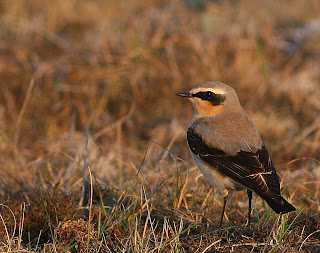

Wheatear (Joe Cockram)
We spent some time looking at plants on the sand dunes. There is a fine display of Heath Dog-violet, Spring Vetch and Early Forget-me-nots. The most abundant flowering plant on the reserve at the moment is probably Danish Scurvy-grass. There are also a few flowering Thrift plants and a few patches of Spring Beauty and Sea Campion. However, there are not sufficient flowers to support many butterflies. We didn’t see any on our transect. However we did see a Small Copper and Small Tortoiseshell in the morning. The only other butterfly seen so far this season was a Peacock on the 20th of April. In the coming months more and more flowers will come into bloom attracting more and more butterflies.
The pleasant conditions brought a number of visitors to the point today. More than we have seen for many days. It was nice to see lots of people enjoying the reserve. We would like to remind visitors not to enter fenced off areas in order to prevent disturbance to vulnerable nesting birds. Also, in the areas where dogs are permitted, we ask that they are kept on leads to reduce disturbance.
- Ajay
- Ajay
Subscribe to:
Posts (Atom)