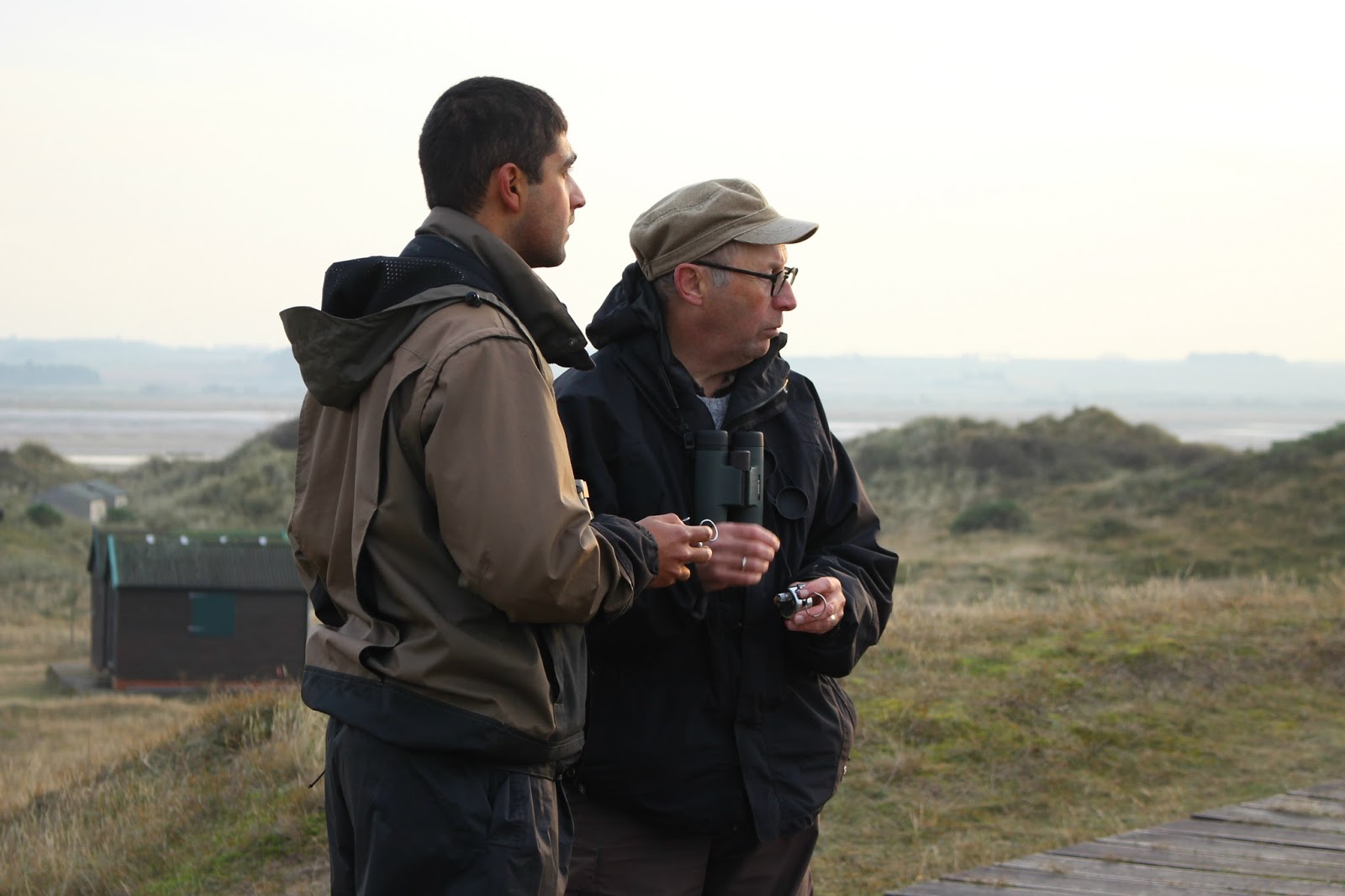
A new Ranger team has just moved into the Lifeboat Station on Blakeney Point. Luke, Ryan and I will be out on the Point until the end of September, helping care for our internationally important tern and seal colonies, while continuing the now 116 year tradition of wardens on the Point. Come say hello if passing by, and let us know about your stories and sightings.
As you can see, what a wonderful place to spend summer! Having moved from the Gulf Stream blessed beaches of Pembrokeshire I can certainly confirm it's cold by the North Sea; yet with a bounteous array of wildlife bouncing about right outside the front door, plus the best possible sunrises and sunsets, resplendent night time skies, and (thankfully) a wood burning stove, it seems we're well set.
Blakeney's wonderful raptors have completely caught our imaginations in our first month here. It seems all we'd need to complete a full set of postcards is a displaced golden eagle. We've identified kestrels, peregrines, marsh and hen harriers, red kites, a merlin, a short eared owl and today, while wandering through the dunes, I quite literally almost stood on a feasting sparrow hawk; he was to consumed with gobbling his prey to hear me coming.
The first little terns were identified arriving on 21 April, while as of 26 April there were 300 or so sandwich terns roosting on the Point. Other fantastic sightings, all firsts for me, include 3 eider ducks, a velvet scoter, Greenland wheatears, a Caspian gull and today a couple of common scoter.
We've seen our first butterflies and moths of the summer, including quite a few small coppers flittering among the dunes, and this quite beautiful emperor moth...come on, who says moths are dull?
Howard Jones, Ranger
Thursday, 27 April 2017
Tuesday, 18 April 2017
18th of April: Spring shoots
Change is very visible on Blakeney Freshes at the moment. In less than a month, the area of reedbed we cut in February has been growing back fast, with green shoots rising above the water.
We control the water levels to benefit wildlife. In February, we dropped the levels to as low as possible, in order to access the reedbed to carry out our habitat management work. We have since raised the water table to make the Freshes suitable for breeding wading birds. Avocets are nesting on small islands surrounded by water, whilst Lapwings and Redshanks are nesting in amongst the grass. A Little Ringed Plover has also been seen this week.
Other sightings in the last few days include Water Vole, Swallows passing westwards and a Mute Swan nest...
Elsewhere on the reserve, recent sightings include Firecrest, Short-eared Owl and Peregrine on Blakeney Point and Wheatear on Morston Marshes. There are approximately 130 Sandwich Terns roosting on Far Point.
Also on the Point, the usual patch of Sea Kale is re-emerging from underneath the shingle to the east of the Watch House. This is the only place on the reserve that it grows.
Our latest low tide seal count - conducted on Tuesday 11th April - recorded 98 Grey and 57 Common hauled out on Stiffkey West Sands.
23rd March
18th April
We control the water levels to benefit wildlife. In February, we dropped the levels to as low as possible, in order to access the reedbed to carry out our habitat management work. We have since raised the water table to make the Freshes suitable for breeding wading birds. Avocets are nesting on small islands surrounded by water, whilst Lapwings and Redshanks are nesting in amongst the grass. A Little Ringed Plover has also been seen this week.
Other sightings in the last few days include Water Vole, Swallows passing westwards and a Mute Swan nest...
Also on the Point, the usual patch of Sea Kale is re-emerging from underneath the shingle to the east of the Watch House. This is the only place on the reserve that it grows.
Our latest low tide seal count - conducted on Tuesday 11th April - recorded 98 Grey and 57 Common hauled out on Stiffkey West Sands.
- Ajay Tegala, Ranger
Thursday, 9 March 2017
9th of March: Spring is in the air
The starlings in my garden are wolf-whistling at each other
and the blackthorn in the hedgerows is coming into flower – spring is springing
everywhere, including Blakeney. We’re
starting to see birds pairing off for the breeding season on the reserve,
including stonechats on Friary Hills, reed buntings on the marsh and
oystercatchers along the shingle ridge of the Point. Our largest count of grey partridge pairs on
Blakeney Point was an estimated 15 pairs on 24th of February, growing
from six on Valentine’s Day and smashing all previous records. We have also regularly seen a gang of six
shore larks still hanging around the Point, which always brighten our day.
In February we said goodbye to the last grey seal pup born quite
late on the Point this year, pictured below (exactly three weeks after it was
first found) fully moulted and in good condition for independence.
![]() |
| The last seal pup on Valentine's Day (photo: Mary Goddard) |
Our trail camera on a gate post on Blakeney Freshes is a
fantastic tool for seeing what birds of prey are about and we have been getting
some lovely footage recently. Below is a
selection from the last month including a kestrel having a stretch, a barn owl
on a calm and misty morning and two buzzards that can be differentiated as
individuals by the varying amounts of pale plumage on their chests. My favourite, though, is the sparrowhawk
being startled by masses of pink footed geese coming in to feed on the field
behind.
A kestrel stretching
Barn owl in the mist
Buzzard number 1
Buzzard number 2
Sparrowhawk and pink footed geese
With
ditching works on the Freshes completed in January, next has been the annual reed
cutting. This is done in blocks on a five
year rotation, which helps to prevent the humus layer from building up and
allowing succession of scrub, whilst also maintain the heterogeneous mosaic of
different age structures that benefits reed bed wildlife. During this work we came across an
interesting fungus growing out of the base of a reed stem, which I took some
(bad) photos of to send to local fungi expert Tony Leech for help
identifying. Unfortunately my terrible
photography made this difficult, but I was able to re-locate the specimen and
collect it to pass on to Tony for inspection.
He identified it as Mycena
belliarum (or reed bonnet), a
rare fungus for which East Anglia is a strong hold. Since the 1950s the species has been recorded
at three other sites in Norfolk, one in Suffolk and one in Huntingdon.
| Mycena belliarum found at Blakeney (photo: Tony Leech) |
Finally is
to report a little gem found at Morston while we were installing some new
signage and dog bins – harvest mouse nests.
We found a couple in some long grass just off the track, beautifully
camouflaged. The female harvest mouse (Mycromys minutus) builds this spherical
grass nest solely for the purpose of raising her young, creating a new nest for
each litter she has. The fact that we
found two in such close proximity possibly indicates multiple litters by the
same mouse.
| A harvest mouse (Mycromys minutus) nest (photo: Mary Goddard) |
Post by Mary Goddard, Assistant Ranger
Monday, 6 February 2017
6th of February: Blakeney wildlife update
Here at Blakeney National Nature Reserve, February is the month that follows the end of the Grey Seal breeding season and precedes the start of the breeding bird season. In preparation for the upcoming breeding bird season in March, the ranger team have been carrying out habitat management work...
A late Grey Seal pup was discovered in the dunes in the second half of January. On Thursday 2 February, we noticed it had moulted and was about to become the 2,367th pup to be weaned on Blakeney Point this winter.
This takes the total weaned to 2,368 thanks to the efforts of the East Winch team who fed the pup for two months, enabling him to get up to a healthy weight ready to fend for himself in the North Sea. Hobgoblin weighed 14.5kg on arrival and was released on 1 February having reached 45kg.
On Blakeney Freshes, we completed our annual ditching works at the end of January. This involves contracting a digger to clear out some of the ditches, preventing them from becoming too clogged up with vegetation, to allow better flow of water around the Freshes and enable a greater diversity of wildlife. This work is done on a rotation. The same applies for reed cutting, which we will be completing in February. This stops woodier species from taking over the reedbed and drying it out, thus conserving the reedbed habitat for nesting Marsh Harriers, Bearded Tits and - in some years - Bitterns, as well as invertebrates that live in the reed stems.
Blakeney Freshes (Ajay Tegala)
Recent wildlife sightings on Blakeney Freshes include a male Hen Harrier, two Stonechat pairs, 7+ Bearded Tits, Snipe and also two Scaup in Blakeney Harbour on 31 January. On the same date, 872 Wigeon and 93 Teal were counted on the Freshes.
On 21 January, we took part in a coordinated Brent Goose roost count across the coast. Approximately 1,600 roosted at Stiffkey, which is over 1,300 more than last year's count. Numbers roosting in Blakeney Harbour were similar to last year, with 1,135 counted. It won't be too long before the Brent Geese begin migrating to their breeding grounds in the Arctic Circle, where their breeding success is related to Arctic Fox predation.
A late Grey Seal pup was discovered in the dunes in the second half of January. On Thursday 2 February, we noticed it had moulted and was about to become the 2,367th pup to be weaned on Blakeney Point this winter.
In addition, Hobgoblin (the orphaned male pup that turned up in the car park at Morston on 21 November) was released after being cared for by the RSPCA at East Winch.
Hobgoblin (Kirsty Dickson)
This takes the total weaned to 2,368 thanks to the efforts of the East Winch team who fed the pup for two months, enabling him to get up to a healthy weight ready to fend for himself in the North Sea. Hobgoblin weighed 14.5kg on arrival and was released on 1 February having reached 45kg.
The RSPCA team also recently released Milkbottle, a young female Common Seal that we rescued from the beach at Salthouse on 22 August. She weighed just 10.5kg on arrival at East Winch and had increased to a healthy 46kg when she was released on 2 January.
Our most recent low tide seal count recorded 68 Grey Seals (4 weaned pups and 64 adults) and one juvenile Common Seal on 2 February.
Last week's sightings on Blakeney Point included a male Merlin on 30 January, two Glaucous Gulls on 31 January and six Shore Larks in Great Sandy Low on 2 February.
Also on 2 February, 42 Grey Partridges were counted, including three pairs; we hope 2017 will be another good year for breeding success.
Ajay, Ranger - Blakeney National Nature Reserve
Juvenile Glaucous Gull (Richard Porter)
Also on 2 February, 42 Grey Partridges were counted, including three pairs; we hope 2017 will be another good year for breeding success.
Ajay, Ranger - Blakeney National Nature Reserve
Friday, 6 January 2017
6th of January: Buoy overshadows seals
Strong winds and rough seas on Wednesday (4th January), caused shifting of shingle on Blakeney Point.
These posts are what remains of a row of telegraph poles that powered a telephone at the Lifeboat House one hundred years ago. These have been exposed considerably by the landward rolling of shingle caused by Wednesday's weather.
It wasn't only shingle that shifted. The large buoy that marks the Hjordis wreck came off it's anchor chain and washed up on the Point, overshadowing a couple of weaned Grey Seal pups on the beach...
The buoy marks the Hjordis wreck, at the mouth of Blakeney Channel, to prevent vessels from getting into danger by going too close to the remains of the ship that was wrecked here in 1916. Due to the channel moving eastwards over the previous winter, Blakeney Harbour Association installed a number of new marker boys in 2016 for the safety of Blakeney's many boat users. After liaising with Blakeney Harbour Association, who put out a navigation warning, we set about the task of retrieving the buoy. Fortunately, despite its bulkiness, we were able to load it onto our trailer and toe it to Morston.
Wednesday's weather had little impact on the Grey Seal rookery. The adults and weaned pups are fast dispersing. However, there have been four pups born in 2017.
These four take the season's total to 2,368 pups. This number is now unlikely to rise by more than one or two. This total represents a 1% increase on last season's.
With 34 either stillborn or not surviving their crucial first few days, there has been a total of 2,402 births this season. This represents a very low <2.5% mortality, showing what a successful and productive rookery Blakeney Point is.
We would like to thank all visitors for respecting the seals, helping them to have a disturbance-free environment in which to pup. A great big thank you also to the RSPCA staff and volunteers at East Winch for doing an excellent job caring for sick and injured pups from Blakeney.
Notable wildlife sightings on Blakeney National Nature Reserve this week included:
- Harbour Porpoise (washed up dead), Blakeney Point on Tuesday 3rd
- Hen Harrier (ringtail), Morston Marshes on Wednesday 4th
- Two Glaucous Gulls, Blakeney Point on Thursday 5th
- Four Snow Buntings, Blakeney Point on Thursday 5th
- Two Whooper Swans, over Blakeney Freshes on Thursday 5th
We look forward to sharing wildlife news from across the reserve throughout 2017.
- Ajay, Mary & Graham (Rangers)
These posts are what remains of a row of telegraph poles that powered a telephone at the Lifeboat House one hundred years ago. These have been exposed considerably by the landward rolling of shingle caused by Wednesday's weather.
It wasn't only shingle that shifted. The large buoy that marks the Hjordis wreck came off it's anchor chain and washed up on the Point, overshadowing a couple of weaned Grey Seal pups on the beach...
Buoy overshadows seals (Graham Lubbock)
...and our volunteer Richard Porter (Ajay Tegala)
The buoy marks the Hjordis wreck, at the mouth of Blakeney Channel, to prevent vessels from getting into danger by going too close to the remains of the ship that was wrecked here in 1916. Due to the channel moving eastwards over the previous winter, Blakeney Harbour Association installed a number of new marker boys in 2016 for the safety of Blakeney's many boat users. After liaising with Blakeney Harbour Association, who put out a navigation warning, we set about the task of retrieving the buoy. Fortunately, despite its bulkiness, we were able to load it onto our trailer and toe it to Morston.
Loading the buoy onto the trailer (Ajay Tegala)
Beginning the drive along the beach (Mary Goddard)
Delivered safely to Morston (Graham Lubbock)
Wednesday's weather had little impact on the Grey Seal rookery. The adults and weaned pups are fast dispersing. However, there have been four pups born in 2017.
One of this January's newborn pups (Ajay Tegala)
These four take the season's total to 2,368 pups. This number is now unlikely to rise by more than one or two. This total represents a 1% increase on last season's.
With 34 either stillborn or not surviving their crucial first few days, there has been a total of 2,402 births this season. This represents a very low <2.5% mortality, showing what a successful and productive rookery Blakeney Point is.
We would like to thank all visitors for respecting the seals, helping them to have a disturbance-free environment in which to pup. A great big thank you also to the RSPCA staff and volunteers at East Winch for doing an excellent job caring for sick and injured pups from Blakeney.
Notable wildlife sightings on Blakeney National Nature Reserve this week included:
- Harbour Porpoise (washed up dead), Blakeney Point on Tuesday 3rd
- Hen Harrier (ringtail), Morston Marshes on Wednesday 4th
- Two Glaucous Gulls, Blakeney Point on Thursday 5th
- Four Snow Buntings, Blakeney Point on Thursday 5th
- Two Whooper Swans, over Blakeney Freshes on Thursday 5th
We look forward to sharing wildlife news from across the reserve throughout 2017.
- Ajay, Mary & Graham (Rangers)
Saturday, 31 December 2016
31st of December: Happy new year (and latest pup count)
The National Trust Norfolk Coast team would like to wish all readers of our blog a very happy new year.
It was a lovely bright and clear day at Blakeney today. We conducted a Grey Seal pup count on the Point, recording 23 pups born since our previous count. This takes our running total to 2,362 live pups, which is 19 more than the last year's total.
Best wishes for 2017,
Ajay [Ranger]
It was a lovely bright and clear day at Blakeney today. We conducted a Grey Seal pup count on the Point, recording 23 pups born since our previous count. This takes our running total to 2,362 live pups, which is 19 more than the last year's total.
Photo: Ian Ward
Best wishes for 2017,
Ajay [Ranger]
Thursday, 22 December 2016
22nd of December: Happy Christmas (and latest pup count)
The National Trust Norfolk Coast team would like to wish all readers of the blog a very happy Christmas.
Today, we conducted our last pup count before Christmas, which takes the total up to 2,339 pups. This is just three less than last season's total and we still expect a few more births over the next couple of weeks.
If you are thinking of visiting Blakeney Point during the Christmas holidays, we recommend Bean's and Temple's seal ferry trips that go regularly from Morston Quay.
If you are thinking of walking up the Point, please visit our web-site for advice and information on responsible viewing, and follow on-site information.
-Ajay
Today, we conducted our last pup count before Christmas, which takes the total up to 2,339 pups. This is just three less than last season's total and we still expect a few more births over the next couple of weeks.
The count included one pup that had literally just been born...
Cow with newborn pup (A. Tegala)
Our next count will be between Christmas and New Year.
Pup resting on the beach (A. Tegala)
If you are thinking of visiting Blakeney Point during the Christmas holidays, we recommend Bean's and Temple's seal ferry trips that go regularly from Morston Quay.
White 'puppy' fur shed by a pup (A. Tegala)
If you are thinking of walking up the Point, please visit our web-site for advice and information on responsible viewing, and follow on-site information.
Thursday, 15 December 2016
15th of December: Seal pup update
Today, the ranger team were out checking the Grey Seal colony on Blakeney Point. A large number of pups are now weaned and have been left by their mothers. But pups are still being born daily.
There are pups in various states of moult...
A number of the weaned pups are stretching their flippers and moving around the dunes, some straying out of fenced areas and onto paths. Please give seals a wide berth, including any adults that may be outside of the fenced areas too. With bulls fighting over territories and trying to mate with cows, the colony is a dramatic but dangerous place.
Seals are not the only wildlife stars of Blakeney at the moment. This week, over 400 Pintail were counted in the harbour. Other notable wildfowl records include Scaup, Goldeneye and a few dozen Red-breasted Mergansers. The Shorelarks haven't been seen for a few days, but up to 20 Snow Buntings are still being seen daily.
- Ajay Tegala (Ranger)
Young pup with mother (Jemma Finch)
There are pups in various states of moult...
Moulting pup (Jemma Finch)
A number of the weaned pups are stretching their flippers and moving around the dunes, some straying out of fenced areas and onto paths. Please give seals a wide berth, including any adults that may be outside of the fenced areas too. With bulls fighting over territories and trying to mate with cows, the colony is a dramatic but dangerous place.
Cow (Jemma Finch)
Bull (Jemma Finch)
Today's pup count takes our running total to 2,242 (plus two in the care of the RSPCA). Pupping is slowing down but will continue into the new year. We will keep you updated with our counts.
Ajay and Al totting up figures (Jemma Finch)
- Ajay Tegala (Ranger)
Saturday, 26 November 2016
26th of November: Boardwalkers won't be bored walkers
Today we were visited by Zoe Frank from the Yorkshire Coast, where there is a small Grey Seal colony at Ravenscar, which she manages. She had come to see how we monitor the seals at Blakeney during the pupping season and so we undertook a count together.
With the prime pupping areas on the beach fully occupied, some seals have moved into the dunes to give birth. Whilst we try to fence off as much of the colony as possible, we ask walkers to be aware that seals don't respect our fence-lines. This morning, there was a birth on the boardwalk, so we urge visitors to give mother and pup a wide berth.
The mothers are protective and become distressed if people go too close to their pups or linger nearby. Please remember seals are also dangerous and have sharp teeth. We would like to thank visitors for their understanding and cooperation.
There are now several moulting pups...
With the prime pupping areas on the beach fully occupied, some seals have moved into the dunes to give birth. Whilst we try to fence off as much of the colony as possible, we ask walkers to be aware that seals don't respect our fence-lines. This morning, there was a birth on the boardwalk, so we urge visitors to give mother and pup a wide berth.
Today's count totalled an impressive 1,553 pups.
It's not just seal pups that we have a good number of. This week we counted 54 Grey Partridges in the dunes. It is encouraging to see this bird species, which has declined dramatically in recent times, doing well on Blakeney Point.
- Ajay, Ranger
Wednesday, 23 November 2016
23rd of November: Pup count exceeds 1,000
Today's pup count exceeded a thousand, with a grand total of 1,191 pups counted on Blakeney Point.
All is looking very healthy in the colony, which has now filled most of our fenced restricted area.
Please respect the fences and on-site signs if visiting, and look out for our wonderful volunteers who will be on site at weekends.
On Monday, a lone pup was found under a boat in the car park at Morston. It had probably washed up there in the big tides over the weekend...
We picked the poor pup up and took it to the excellent RSPCA East Winch wildlife hospital where it is now in good hands - and has been named Hobgoblin by our volunteer Sabrina.
- Ajay (Ranger)
All is looking very healthy in the colony, which has now filled most of our fenced restricted area.
Please respect the fences and on-site signs if visiting, and look out for our wonderful volunteers who will be on site at weekends.
Young pup (Ajay Tegala)
On Monday, a lone pup was found under a boat in the car park at Morston. It had probably washed up there in the big tides over the weekend...
Hobgoblin (Kirsty Dickson)
We picked the poor pup up and took it to the excellent RSPCA East Winch wildlife hospital where it is now in good hands - and has been named Hobgoblin by our volunteer Sabrina.
- Ajay (Ranger)
Subscribe to:
Posts (Atom)