Thursday, 29 November 2012

Countryfile & the Lifeboat house refurb project

As promised, here is another photo from the Countryfile filming last week. In this photo Eddie and Julia are looking over the rookery talking about our conservation and monitoring work and a new photo id project that we are starting to understand better site faithfulness of the female seals.


The Lifeboat house refurb project is going well. Progress so far includes the site being set-up, breaking up the old concrete steps, driving in timber piles for the new ramps and erecting the scaffold.


 Inside the visitor centre, an old window is being revealed - just the outside cladding to go next


Other work happening inside is the removal of a 2nd kitchen to make way for a new office for the Ranger team

Tuesday, 27 November 2012

The last week

Hello everyone,

I am aware that it's been nearly a week since we last updated the blog so here is a flavour of what we have been up to.

The week began with good discussions about opportunities to volunteer with us and we are likely to be advertising specific roles to help our work in 2013. We also developed a proposal for a group of corporate volunteers, which reflects the breadth of work across the Horsey & Heigham Holmes, Blakeney and Brancaster areas we look after. They follow our work on the blog and we are really pleased they got in contact with us to identify ways to be involved.

I spent most of Tuesday around the Burnham/Brancaster area with Ranger Keith planning some of the winter works we will be undertaking e.g. hedge & tree maintenance. Meanwhile the grey seal pup colony or rookery was being counted and had grown to 475.

The middle of the week saw Graham and volunteer ranger Malcolm prepare Blakeney freshes for the winter. Now the cattle have been taken off, we shut down the water supply to the troughs and emptied them and did work to the many field gates that allow us to have control over where the cattle are grazing. Eddie did another seal count, with a dramatic rise to 593!

Thursday was an interesting day for us with BBC Countryfile coming back to film our conservation and monitoring work to look after the grey seal colony. We hope to do another post about this and the how the lifeboat house refurb work is going in the next day or so, but here is a sneek preview.


Eddie with Julia Bradbury


On Friday we hosted a guided birdwatching walk with the ranger team and saw marsh harriers, Bewicks swans, godwits, lapwings, pink-footed and Brent geese amongst others.

The week concluded with Eddie being on call for any sick or injured seal pups. 

Victoria, Countryside Manager

Wednesday, 21 November 2012

News from Brancaster Activity Centre

It’s the time of year for the pink-footed-geese to return to Scolt Head every evening – we usually hear them honking as they fly over the office - and it’s time for those lovely autumn sunsets over the marsh too. 


This last week our two long-term volunteers have been doing their sailing training with Rob and Alex our resident instructors, whilst Nita and Nige have been getting in some power boat experience -  practicing towing the sailing boat off the mud and admiring the passing wildlife - marsh Harriers, a grey seal and a guillemot surfacing right by the boat were the highlights.

We have the first of our Special Interest weekends coming up - ‘Autumn Migrants’ followed by ‘Winter Walking Break’ then a Dickensian themed cookery day and ‘Wildlife Walks for Photographers’.  Alex has been busy putting together the Special Interest programme for 2013 and it contains our usual selection of art, wildlife and our now regular yoga week-end.  We’re also planning our school holiday programme of taster sessions – we used to call these ‘drop-in’ sessions, but they now book up in advance particularly for watersports – once again we’ll be doing Kayaking, Sailing and Raft Building along with Coastal Safari and other exploration days. 


It’s exciting times as we put together the plans for our new Young Ranger Award – all our visiting school pupils will benefit from getting this new award this year; and as we do every winter the staff work hard to ensure all our activities remain relevant and up-to-date. This winter we should see the completion of the long-awaited Roman Activity and a re-vamp of our field studies programme.

As always the centre is open for hire over the winter when there are no residential school bookings, - so if you fancy a winter break by the coast or have a meeting to host in the area why not contact us to see what we could offer.

Wednesday, 14 November 2012

14th of November: Events and pups

With winter fast approaching the Point and surrounding marshes are starting to assume a distinctly wintery feel. The seals have taken over the Point and are squashing down the dune grasses on Far Point with the weight of the bulls and cows (and their associated pups) as they go about their ‘all or nothing’ breeding cycle. Draper and Nichols have taken control of the Lifeboat House and work is progressing as planned.

Piling posts for the verandah to be reinstated on the Lifeboat House (Graham Lubbock)  

Seal pup counts have been interesting and it seems that almost 40 are being born each evening (probably all under the cover of darkness). Yesterdays (13th of November) pup count was 252 and today 293 were counted which is double the number counted at this time last year. Counting the pups is made incredibly difficult by the lie of the land and by the fact that the entire breeding population is on one long beach, but by using a counter and making sure that you have seen into all of the dips, bays and on all sides of every dune a fairly accurate count can be made. We are also looking into photo recognition of individual cows and marking any pups relocated back to the rookery with sheep dye. Far Point should be avoided by walkers at this time of year to avoid disturbance to the seals and dogs should kept on leads. However, the rookery can be watched from the seal ferries which leave from Morston Quay at around high tide and a few outlying seals can be observed at a distance on land before you reach the no further signs.

A cow (F1) photographed for individual identification (Edward Stubbings)

We still have a few places available on our guided ‘Wintering wildfowl and Waders’ (birdwatching) walk on Friday 23rd November starting at 10:00 from Morston Quay and our  ‘Blakeney Point Seal Pup Tour’ on Friday 7th December starting at 10:15 (also from Morston Quay). It is a great opportunity to see the arrival of the seal pups and the posturing and fighting of the adult bull seals. If you are interested advanced booking is essential so please contact the booking office on 08442491895.  And dont forget James' exhibition at Blickling Hall, starts this Friday.

Mother and pup in creek just before the start of Far Point (Graham Lubbock)

- Eddie

Thursday, 8 November 2012

8th of November: The Long Wild Shore

Between the 17th of November and the 2nd of December Blickling Hall will be hosting an exhibition and book launch of the extremely talented, former Point warden, James McCallum. The Long Wild Shore - Bird and Seal Seasons on Blakeney Point, his new book, covers most of the wildlife found on the Point, some in great detail, including the terns and seals. The exhibition runs from the 17th of November until the 2nd of December and will be open from Wednesday through to Sunday between 11am and 4pm. There will be additional openings during the Blickling Christmas Weekends - 8th-9th and 15-16th of December, which are a treat in their own right. The launch of this long awaited book is expertly timed to coincide with our centenary. The Point was brought for the trust in 1912. One hundred years on and James has become a part of that long and illustrious history. More information about James and his work can be found on his website http://www.jamesmccallum.co.uk/. A recent article in British Birds entitled The Birds of Blakeney Point: 100 Years of National Trust Ownership features some of James' paintings and, along with his new book, celebrates our centenary and the amazing wildlife to be found on the reserve. James was Assistant Warden on Blakeney Point and Blakeney Freshes in 1994, 1995, 1996, 1999, 2003 and 2006 and added greatly to our understanding of the breeding birds of the Point and the Freshes as well as helping in the species protection which makes Blakeney NNR such a great place for birds. James is always friendly and accommodating and would love to see you at the exhibition.

Bluethroat in May 2012 (James McCallum)

Terns courting and preening with a Grey plover to their left (James McCallum)

After our last blog post from the Point The Bamboozled Ouzel  about the huge 'fall' of Scandinavian migrants which hit our coast on the 22nd of October we received some pictures from Point regular Richard Porter that really show how big the spectacle was. It is now believed that it was the biggest 'fall' of migrants for twenty years and has been dubbed the 'Thrush Rush'.


This impressive picture shows the full scale of the thrush rush on the 22nd of October this year. If you look really carefully (squint your eyes) you can just make out the Lifeboat House on the right
(Richard Porter)

On to mammalian news: the first Grey Seal pup of the season was born on the 26th/27th of October and numbers increased rapidly to 91 on the 7th of November. The colony, or Rookery, as they are correctly called, has been doing extremely well in recent years and the number of pups born has increased significantly year on year. Access to Far Point is now restricted during the winter months to avoid disturbance to the seals and it should be remembered that seals can be dangerous to humans and dogs. The best way to see the pups is from one of the seal ferries which leave from Morston around high tide.


One of the first Grey Seal pups of the winter (Richard Porter)

- Eddie

Monday, 29 October 2012

Burnham overy windmill weekend: Super nature but nothing supernatural

It's not everyday you wake up in a windmill overlooking two National Nature Reserves & next to a National Trail.

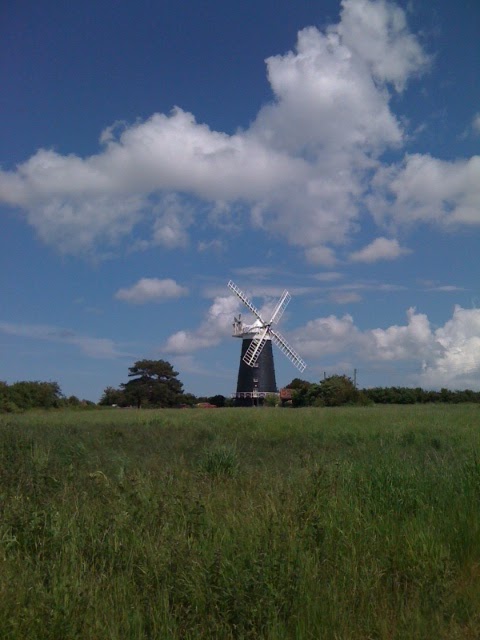
Last weekend I had this very opportunity as I was one of a group of 19 who hired the Tower Windmill in Burnham Overy for 3 nights. 
Being one of the organisers and the closest, I picked up the enormous key and chose one of the two bedrooms in the cottage annex, which is also where the kitchen, pantry, two shower rooms & two toilets are to be found. The ground floor of the windmill is the main living area with two dormitories each with four bunk beds and a fourth library floor. With each rise in storey you got a real sense of the walls leaning in and of course being round.

The kitchen equipment & crockery was put to a real test on the first night as three main courses and side dishes for 19 were cooked, but there was plenty of implements, huge pots & trays helped by two ovens and an army of 10 dishwashers. The second night was simpler by a torchlit stroll to the local pub which served good food at reasonable prices. At no point were we short of anything, least not tea towels and there was space and tables for everyone to be seated together.

We added bunting & flowers to the main room 

The quirky accomodation was only part of our reason for hiring the windmill, another key bit being the opportunity to get outdoors & close to nature on the North Norfolk coast. Our days were filled exploring the area & nature reserves via the numerous paths, bridleways and lanes, on foot, cycle or hopping along the coast on the Coasthopper bus (nearest stop only being half a mile away). We racked up hundreds of miles between us!

My highlights:

  • Standing on the balcony drinking ginger wine (thanks Graham) under an orange sky listening to pink-footed geese flying overhead to their roosts
  • Amazing views of marshes, dunes, creeks & saltmarsh of Holkham & Scolt Head Island National Nature Reserves
  • Fly-by's by barn owls & marsh harriers & the starlings gathering on the sails at dusk
  • The hare that ran through the grounds and across the road missing the zooming car
  • Being in good company

Top tips:

  • Don't read the visitor book on the first night, some groups talk of haunted mirrors & other spooky happenings
  • If you're sleeping in a dorm pack eye mask & ear plugs
  • Book early via 01263 740241 for an extremely good value break for you, your friends & family

Friday, 26 October 2012

Being a Volunteer Energy Manager on the Norfolk Coast

Guest post written by Peter Justice, Volunteer Energy Manager, about how he came to volunteer with us, his role & projects he's worked on.

I was seconded to National Trust from my employer BT in early 2010 and joined the team at Blakeney.

My initial task was to capture all the 50 plus Health & Safety compliances required along the Norfolk Coast and incorporate these into a spreadsheet. These H&S compliances included Fire Risk Assessments, Work Place inspections, Portable Appliance Testing, Boiler Servicing, Chimney Sweeping etc. Once this spreadsheet was completed, at a glance it would tell you inspection due dates, person responsible and confirmed whether compliant. In addition to this task I assisted the wardens at Horsey, Heigham Holmes, Blakeney, Morston, Burnham and Brancaster. Some memorable projects include moving the Horsey Windpump sails to Heigham Holmes for storage, erecting new signage at Brancaster, Morston and Blakeney & counting the grey seal pups on Blakeney Point.

My background in Communications, electrical and plumbing proved very useful during my secondment when I was able to install a movement detection system in the toilets on Blakeney Point, repair frozen pipes in the lifeboat house, provide heating timers in the Blakeney office and install additional LAN ports to enable additional computer connections for seasonal staff.

Another task I owned while seconded to the Trust was capturing all energy use and updating the Monitoring and Management database on a monthly basis. When my secondment ended in 2011, I continued with this Energy Manager role as a volunteer.


Peter about to read the meters

Today I continue to provide monthly meter reading and deliver data, monitoring energy use along the Norfolk Coast. Energy is a priority in the regional business plan and the Trust has legal obligations under the Governments CRC Energy Efficiency Scheme.

As Energy Manager I am responsible for providing monthly readings for Electricity, Water, Renewable Energy, LPG and Fuel use. This data is then input onto the MMS database where I am able to monitor cumulative energy consumption and update on the NT KPI energy targets. 

Should I find areas where energy could be saved or identify energy that is being wasted, I  inform my Property Manager John Sizer. Recent examples are recommendations around replacing old uneconomical style storage heaters at Burnham Cottages and the Windmill and water leaks at Morston.


The Tower Windmill at Overy has been fitted out with new heaters  


My employers BT are very supportive of my volunteering and award up to three days special leave per year to carry out this role. My day job is working in BT Property where I manage a team of building auditors. My role has certain synergies with my NT secondment in areas around Health & Safety, Compliance and Energy Use. I am proud of BT’s corporate responsibility and sustainability. This year to date BT has donated over 49,000 days to allow BT employees to volunteer in the community.

Peter Justice
Energy Manager

Thanks Peter for all the hard work & excellent problem-solving and it's great that you can transfer your expertise & skills from your day job with BT to helping us on the Norfolk Coast, although being a Spurs and not Norwich City fan, there's still work to do!

John Sizer, Property Manager

Monday, 22 October 2012

22nd of October: The bamboozled Ouzel

It wont be many days before the Libeboat house will be given over to contractors, who will be refurbishing the building over the winter months and the last two wardens left on the Point will be forced to move back to the mainland. In todays foggy conditions we were able to witness and record a huge fall of grounded migrants. Having crossed the North Sea they hit fog over our coast and made the first landfall they could. Most were thrushes (up to 35,000) with hundreds of Robins and Bramblings. The main highlights were: Peregrine and Merlin (which were clearly enjoying the tired food source as we found at least four freshly plucked Robins and two Blackbirds), 1 Long-eared Owl, 1 Short-eared Owl, 3 Grey Wagtail, up to 4,000 Fieldfare, 3,000 Blackbird, 30 Ring Ouzel, 1,500 Song Thrush, c. 25,000 Redwing, 280 Robin, 5 Black Restart, 2 Common Redstart, 80 Goldcrests, 25 Chiffchaff, 1 Blackcap, 400 Brambling, 15 Chaffinch, 2 Siskin, 1 redpoll, 2 Yellowhammer and 2 Snow Bunting. At one point two women from a seal ferry pointed out a bird that had trapped itself in the visitors centre. Surprisingly the bird allowed itself to be picked up first time without a fuss. It was a handsome Ring Ouzel (probably a first year bird) and the two women were delighted to to see such a fascinating bird on migration so close up.

  
The bamboozled Ring Ouzel, caught in visitors centre (Jamie Boulter)

Thrushes flocking in the fog (try repeating that in quick succession) (Jamie Boulter)

Finches flying in (Jamie Boulter)

The first Grey Seal pups will be born in the next week or so and we are now looking forward to a successful winter season.

And well done Amanda.

- Ed

Thursday, 18 October 2012

Amanda's home cooking recognised by BBC Radio 4 Food & Farming Awards

Amanda Newton, head cook at Brancaster Millenium Activity centre made it into the top 10 shortlist of the 2012 BBC Radio 4 Food & Farming awards in the category Best Public Caterer (Best dinner lady/man).

http://www.bbc.co.uk/programmes/b00zxv3j/features/about

We all are thrilled that Amanda's mantra of good home-cooking using local seasonal produce was recognised by the judges.

Speaking to Amanda earlier this week she said she was 'Very pleased to be nominated and to make it into the top 10. Being able to provide a good hearty healthy food sets the children up for a day full of fun activities!'.

Amanda has worked for the Trust as Head Cook for 12 years and always has a beaming smile whenever I see her.

Amanda ready to please hungry schoolchildren


Saturday, 13 October 2012

Boy, there's a lot of bees!

Today's post has been kindly written for us by Richard Rolfe of Morston

Beyond the three bridges that run alongside Morston creek, there is a stretch of higher ground known locally as the Pilot’s Path. Composed of impacted sand, shells and small shingle, it is above the range of even the highest tides.

This year, for the first time, the National Trust put up a sign - ‘Buzz on the marsh’ - to provide information about the mining bees and this seems to have attracted a lot of attention from visitors - just as the bee orchids outside Blakeney did.

There are several species of mining bee in the UK, but those at Morston are Colletes halophilus. It is a nationally scarce bee, found in fewer than 25 sites around the south and east coasts of England from the Solent around to the Humber. It flies from late August through to October, and is associated with high quality saltmarsh habitats, as it provisions its nest cells with the pollen it collects from Sea Aster. The female bees will drink nectar from a range of flowering plants to keep them fueled on their search for sea aster.


I was made aware of these mining bees in the summer of 2011, in an unusual way. I’d taken my then-5-year old grandson Monty to Stiffkey on the Coasthopper bus and was walking back to Morston with him. As we neared Morston, Monty said, “Granpa, can we go and see the mining bees?”

“Mining bees, what are they, Monty? I’ve never heard of them.”

“They’re on the marsh, I’ll show you.” So we went out over the bridges and found the bees where he’d said. Despite living in Morston for over 20 years, I never knew they were there - probably through being too focused on the bird life.

During the summer of 2012, I looked continually for the mining bees. In July, I emailed Victoria at the Trust, partly to compliment her on the signage for the bee orchids, but also to see if she knew where the mining bees might be.
Victoria provided a crucial piece of information - the mining bees are associated with flowering sea aster. This meant I’d started looking several weeks too soon.

But eventually, I walked out onto the Pilot’s Path, and there they were. I arranged to meet Victoria and we took photos for ID purposes, as there are several mining bee species in the UK. 

Victoria photographing the bees nests


They seem to be most prolific on calm, sunny evenings, when thousands can be seen at three main colonies. They are harmless to people and appear to be resilient to walkers and their dogs - their burrows, or ‘mines’ are all along the path - and the sites they’ve chosen are above the September high tides.

Monty (below) was delighted to be reconnected with ‘his’ mining bees and will be looking out for them again next year.

Monty pleased with the buzz on the marsh