Sunday, 20 July 2014

20th of July: Sunny weather


The recent sunny weather has brought lots of butterflies - an increase in Graylings, first Gatekeepers and Essex as well as Small Skippers.

 Essex Skipper on Sea Holly

We also had a day when we had a number of migrant hawkers (16th July) - approximately 40 were recorded on the Point.

Sandwich, Common and Little Tern chicks are now on the wing.  Juvenile Sandwich Terns have been seen fishing.  There are also a number of chicks of all species that have yet to take their first flight, such as the Common Tern chick below:


These chicks are still very vulnerable to predation, so please continue to keep your distance from fenced nesting areas.  The dog restrictions (no dogs allowed on the Point except for around the Lifeboat House if on a lead) are still in place until mid-August for this reason. 

Little Tern chick hatched yesterday (photographed under licence)

Spot the chick (click to enlarge)

We're happy to see our breeding birds feeding well.  Terns are enjoying good fishing close to the colony, with feeding 'frenzies' most days.  Black Headed Gulls are feasting on a recent spate of  freshly hatching insects (often referred to simply as a 'hatch') giving both adults and juveniles an abundance of food. 

'Mini' hatch with gulls gathering to feed

In migrant bird news, Starlings have regularly been present in strong numbers over the past couple of weeks, with over 200 seen today in different groups.  We have been enjoying the company of a Black Redstart that appears to have taken a liking to the Lifeboat House and garden area, as it has been around for just under a fortnight with only a couple of days where it was not sighted.  Arctic Skuas are now regularly being seen harassing terns for their fish, as they survive by stealing fish from other birds (known as kleptoparasitism).  They are amazing birds to watch on the wing, very acrobatic, and apparently were the inspiration behind the British Fleet Air Arm’s first naval dive-bomber, the Blackburn Skua (see Arkive.com).

Our latest low-tide seal count on 13th July gave 449 Grey Seals and 38 Common Seals hauled out on the sands.

And to finish with, our latest guess the legs:

Sarah (Seasonal Ranger)

Sunday, 6 July 2014

6th of July: Lucky ducky

This morning as we went out on patrol, we came across five abandoned Shelduck ducklings, huddled together and shivering in the wet grass not far from the Lifeboat house.

After a  brief debate a rescue was decided upon, Ajay was like a pied piper figure as he led the ducklings back to the Lifeboat house.

Once here we found a cardboard box which we lined with cotton wool and towels as well as a toastie warm hot water bottle.

An internet search revealed that we did not have what was required to brood these fluffy humbugs, so the RSPCA were called. We then put the ducklings on a Temple's seal ferry where they were taken away to Morston, to be collected and sent to East Winch animal hospital.

Five Fluffy Humbugs
Five shivering ducklings sat in the dune
Need to do something, need to do soon
Led them away to a nice cosy home
Warm and safe, where no dangers roam
Happy ducklings now whistle a content tune
Safety at East Winch awaits them all soon


Seals
On the 29th of June, a low tide count revealed 865 Grey and 26 Common seals hauled out around the Point and West Sands.

Birds
On the 5th of July, we saw the first fully fledged Sandwich Tern of the season flying over the Gap giving its distinctive call. A full chick count will take place soon.

Return migration has begun, with Whimbrels being seen and heard, for the last few days and a couple of young Yellow Wagtails, and two drake Eiders in eclipse plumage off the tip of Far Point. 

Moths and Butterflies
Tis national moth week this week, and to celebrate we ran a moth trap on the 4th of July, which caught a few impressive species, amongst them were the giant of our native moths, the Privet Hawkmoth, plus Garden Tiger, Ruby Tiger, Oak Egger, Drinker and my favourite the Buff-tip, a master of camouflage, looking exactly like a broken branch of a Silver birch tree. See our facebook page for moth photos.

Grayling butterflies  - a dune specialist - are now on the wing, and can be seen feeding on Sea Lavender and other flowers among the dunes. Their mottled plumage makes them hard to see at rest, but they soon become visible when taking flight.


There is much to be seen and heard, you just got to remember to look and listen.

- Paul

Sunday, 29 June 2014

29th of June: Seeing the unseen

The use of trail cameras (also known as camera traps) on Blakeney Point enable us to capture moments we would not otherwise witness. Here we see a Common Tern presenting a crab to its mate at their nest.

The same Common Tern nest, at night:
 

Sandwich Terns are perhaps not the most hygienic of birds. They do not leave the nest to defaecate, resulting in a white 'sunburst' effect around the nesting area.
This image also shows just how closely Sandwich Terns nest together. These ones have been brave enough to nest around a Black-headed Gull.

Visitors to the Point are more than likely to see Oystercatcher chicks at this time of year. The chicks are nidifugous, meaning that they leave the nest soon after hatching and well before they are capable of flight. They can be seen being taught to feed by their parents. Please do not go too close to them or linger for too long.

The six Pied Wagtail chicks in the yellow plastic box left the nest yesterday.
This photograph was taken six days earlier.

Orchids are somewhat of a rarity on Blakeney Point. This June, we were delighted to find two in the main dunes.
 Common Spotted Orchid

Southern Marsh Orchid

This week, the first Grayling butterflies of the year were seen on the wing. There have also been a sprinkling of smart Red Admirals.

Today's low tide seal count recorded an impressive 865 Grey Seals along with 26 Commons, on the West Sands.

Yesterday we stumbled upon a year-old Common Seal looking sorry for itself about a mile west of Cley Beach. It appeared to be struggling to breathe, possibly suffering from lungworm. We took it to the car park where the RSPCA came to collect it. They will treat the seal with antibiotics.

Ajay Tegala - Coastal Ranger
Photography: Ajay, Paul, Sarah (National Trust), Ben Collen (University College London)

Monday, 23 June 2014

Saved by the bund...

Following the tidal surge of the 5 December the seawall that surrounds Blakeney Freshes was breached in more than thirty places. 

This left the freshmarsh vulnerable and at risk to saltwater flooding (in fact saltwater has crept in over a further three occasions), which poses as risk to grazing livestock and also delays the recovery of freshwater life. 

When the footpath works were undertaken in a partnership between Environment Agency, Norfolk Trails, Natural England and ourselves many of the breaches were raised just to provide a safe path. 

This left just three really low points, so we decided to build a temporary bund around each of these low points to protect the site whilst the longer-term thinking goes on.

The first step was to survey the area for both height and breeding birds.


 Once done, we were able to start the works.


Using a local contractor the bunds were built at a height we felt would keep out a higher than average tide, should they need to be tested!

Then on the 15 June only a week after the works were completed they were tested and held.


We were debating whether to do this work because it was only temporary and still cost a fair amount of money, but we are all really pleased we took the decision to!

Graham Lubbock
Coastal Ranger

Sunday, 22 June 2014

22nd of June: Many Archers, but no Arrows

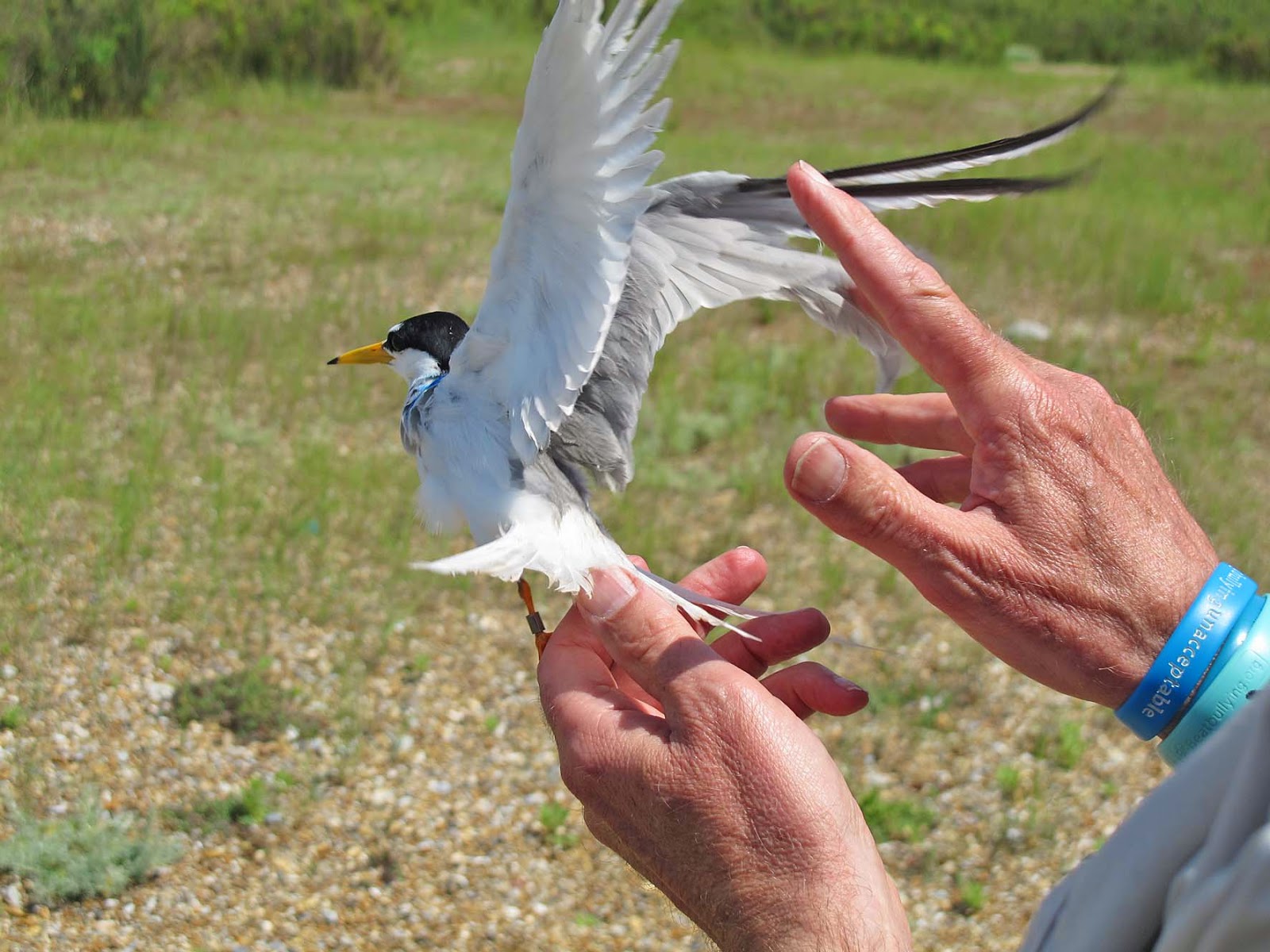
As regular readers should be aware, the National Trust is involved in an EU funded partnership to protect the Little Tern by understanding their movements and behaviours better. So on the 12th of June, two RSPB ringers, with assistance from the NT rangers (us), managed to ring four adult Little Terns.

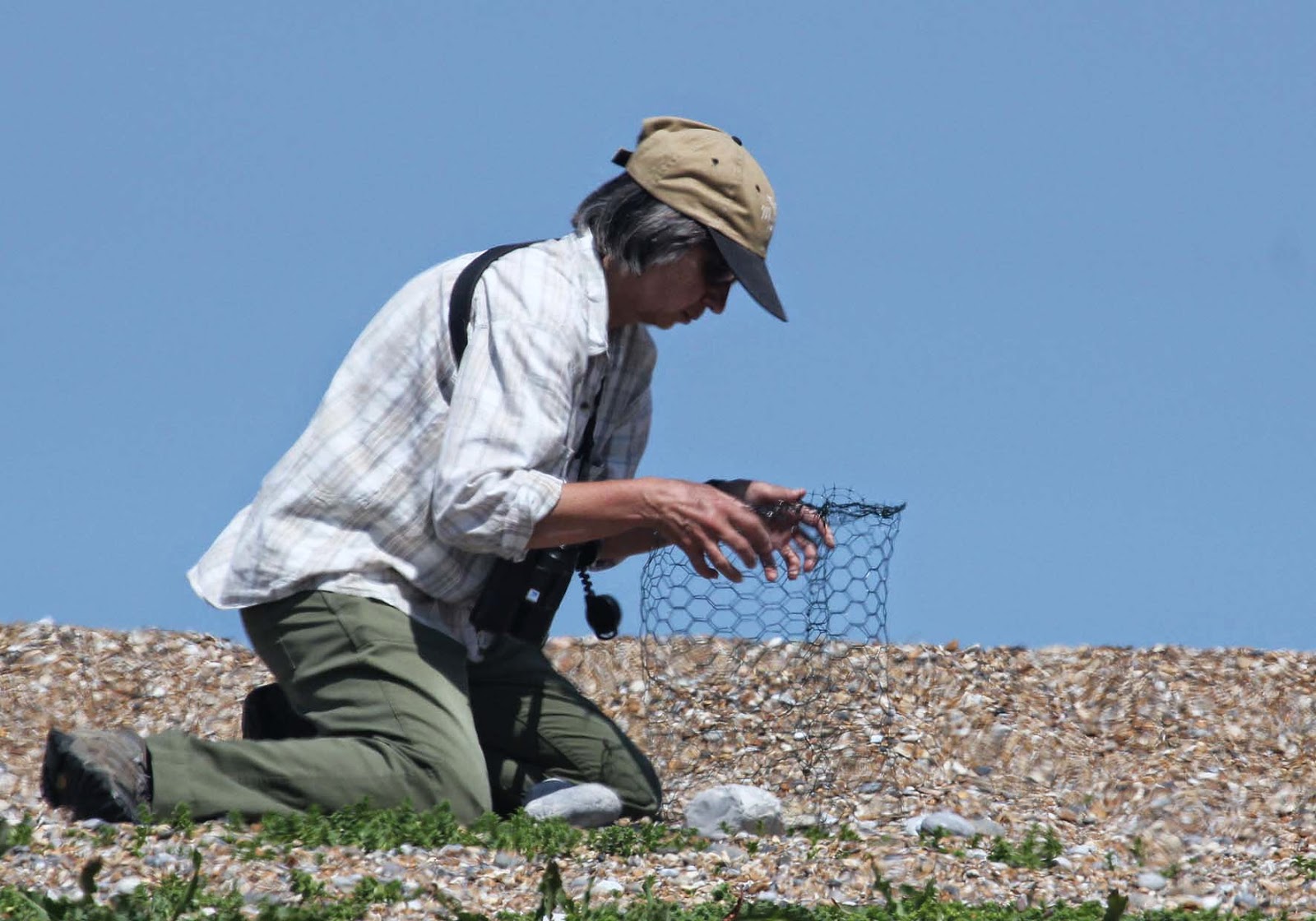
A scrape cage consisting of wire mesh is placed over a bird's eggs. Upon return they enter through a small slit, but are unable to get back out.


The birds were fitted with a normal metal ring and also an individually marked colour-ring with a unique three-letter code: UB5, UB6, UB7 and UB8.


Wings are measured


Measuring head and bill length


Dye is added to identify ringed birds


Many observer hours now need to be put in to learn about these tiny sea birds.

Butterflies
On the wing now is the beautifully-marked Dark Green Fritillary butterfly, Norfolk's only fritillary. Look out for them in the dunes on warm days.

Moths
The Hornet moth is a member of the Clearwing family and is a superb mimic of the hornet. Sightings of this moth have been occurring in the Plantation for the last four years. Breeding was suspected, so on the 9th of June the rangers conducted a survey, which involves checking the bases of poplar trees for exit holes. a total of 12 were found, some with pupal cases protruding, along with a freshly-emerged adults.
Above: pupal case. Below: emerged moth.


A recent moth trap, on the 21st, produced a few nice species, including:
Pine Hawkmoth
.
Shark
.
Bright-line Brown-eye
 .
Brown-line Bright-eye
 .
Light Arches
.
 Buff Arches
.
Dark Arches
.
Archer's Dart

To finish with, we are delighted to announce that all four of our tern species now have chicks...
Above: Common Tern; Below: Little Tern
Paul Nichols,
Ranger
(Photography by Paul, Sarah, Ajay, except Little Tern ringing by Richard Porter)

Tuesday, 17 June 2014

Redshank nest hatches on Blakeney Freshes

On Blakeney freshes, we have been keeping an eye on the progress of a redshank nest. We have captured typical nesting behaviour that can be seen on the three clips below.

Disappearing redshank


Adult redshank share the incubation of eggs, this one is seen returning to the nest where after shuffling the eggs it settles down to become invisible.


Chicks-a-hatching


Upon returning to the nest the adult is seen to be restless and sitting up high, a sure sign that eggs are hatching or that chicks are present.


Chicks appear


After putting in appearances around the nest, 3 1/4 hours later three of the chicks strike out boldly away from the nest.

A normal redshank clutch is four eggs but only 3 chicks were caught on camera.

We'll keep an eye on them and keep you posted.

Chris, Seasonal Ranger


Sunday, 8 June 2014

8th of June: Ringing recoveries

As promised in our last post, here is some footage from our Oystercatcher nest camera. Here an incubation changeover is taking place. Note the droplets of rainwater on their backs.

In other Oystercatcher news, we sadly found a dead bird a couple of weeks ago. The bird had a metal ring on its leg, so we sent off the code to the EU ring web-site. This week we had a response, and were impressed to learn that the bird had been ringed in 1987 - before Ajay was even born! It was ringed along the Norfolk Coast at Snettisham, aged at least three years. That makes the Oystercatcher at least 30 years old, which is quite impressive considering the typical lifespan is just 12 years, and this bird was still breeding. On a slightly less positive note, it confirms our suspicions that we have an aging population of breeding Oystercatchers (in 2009, two ringed Oystercatchers were found to be aged 29 and 32).

In happier news, we are delighted to announce that the first Sandwich Tern chicks hatched this week. If you look closely at the photograph, you can see the egg tooth. This is not a tooth at all, but actually a hardened tip to the bill, used to break through the eggshell.

The adults are working hard to feed their chicks. As the tide receded today, a pool of water was left behind, trapping many fish inside it. This resulted in a feeding frenzy. All four of our breeding tern species were seen indulging, along with a Little Gull.

Finally, the answer to last week's "Guess the Legs" was in fact a Marsh Harrier. Not something you find washed up on the beach very often.

Ajay and Paul,
Blakeney Point Rangers

Wednesday, 4 June 2014

Morston Bridge 2 is complete


Excellent news…..

We inspected the works with Dunnella earlier today and the excellent news is that their efforts over the last 2 weeks mean that we are on programme and have completed the construction of our new bridge.

 Bridge 2 completed - the test piles will be shortly removed

The plan is now to allow public access to the new crossing from Friday 7th @ 3pm,  the temporary scaffolding bridge should no longer be used.  We are waiting for dates from Rise Scaffolding to confirm when the scaffolding will be removed.

We are making minor tweaks to the footpaths either side of the New Bridge, to allow them to connect with our temporary paths.  Once all works are completed we will finalise how we link these in with the original paths and public access.

 Laying the temporary path to Bridge 2

Dunnella will still have their main works access using the lower quay and access for equipment and machinery running alongside Bridge 2 and then on to Bridge 4.

They are now cracking on with laying the deck timbers to the working platform and pontoons for Bridge 4, which will allow them to commence installation of the piles for this structure and the viewing platform.

Piles have arrived today for Bridge 4 and these will be floated to the work area, using local assistance.

Materials will be moved to Bridge 4 along the footpath, using their small dumper and trailer, there may be some localised disturbance of the gravel surface to the path – this is inevitable but we are trying to reduce the impact by limiting the movements and transporting materials where ever possible on a tide with local assistance.

As mentioned originally there may be times when constructing Bridge 4, that we need to reduce access or stop it at times for public and users.  This will be the case when we carryout the Piling for Bridge 4 – it needs time to get the main piles & beams right to allow for the rest of the bridge installation to proceed quickly and efficiently.

We are now looking at the need to alter the existing timber Bridge 4,  as the far end coincides exactly where a number of piles for the viewing platform need to be installed.  The intention is therefore to alter the end of the existing bridge and swing it slightly out of the way – landing on the creek edge a little further up the creek away from the work area.  This operation will take 2 days,  and during this period we will need to provide alternative temporary access during the day across our working pontoon platform (this will be controlled by contractor and National Trust) or will need to temporarily close access.  We will let you know closer to the date when this takes place – and we will discuss further access to limit impact to local moorings and users and will look at timings to reduce inconvenience.

Victoria


Tuesday, 3 June 2014

What is the digger doing on Blakeney Freshes?

Some of you may have spotted a digger on Blakeney Freshes working next to the four major breaches that remain in the northern wall following the tidal surge.

 Mike Page's photo shows Blakeney Freshes a couple of days after the tidal surge hit

Over the last 6 months we have been monitoring water and salt levels on the Freshes and we have noticed that seawater sometimes comes through these breaches if there are either high tides or northerly winds pushing the tide up.

We have seen spikes in salt levels in the ditches and you can see where the grass is brown in places where it has been sitting on the fields. This is not only having an impact on how quickly the freshwater wildlife can return to the affected areas but also poses a risk to how we manage the site through conservation grazing and to the livestock present.

We are undertaking a temporary solution which involves building a low bund on the inside edge of the scour pools and breaches to reduce the chances of the marsh being inundated.

We expect the digger to be on site for a week, completing the work ahead of the next set of high tides.

Today cattle returned to the marshes we look after and it is good to see them on site.

Victoria
Countryside Manager